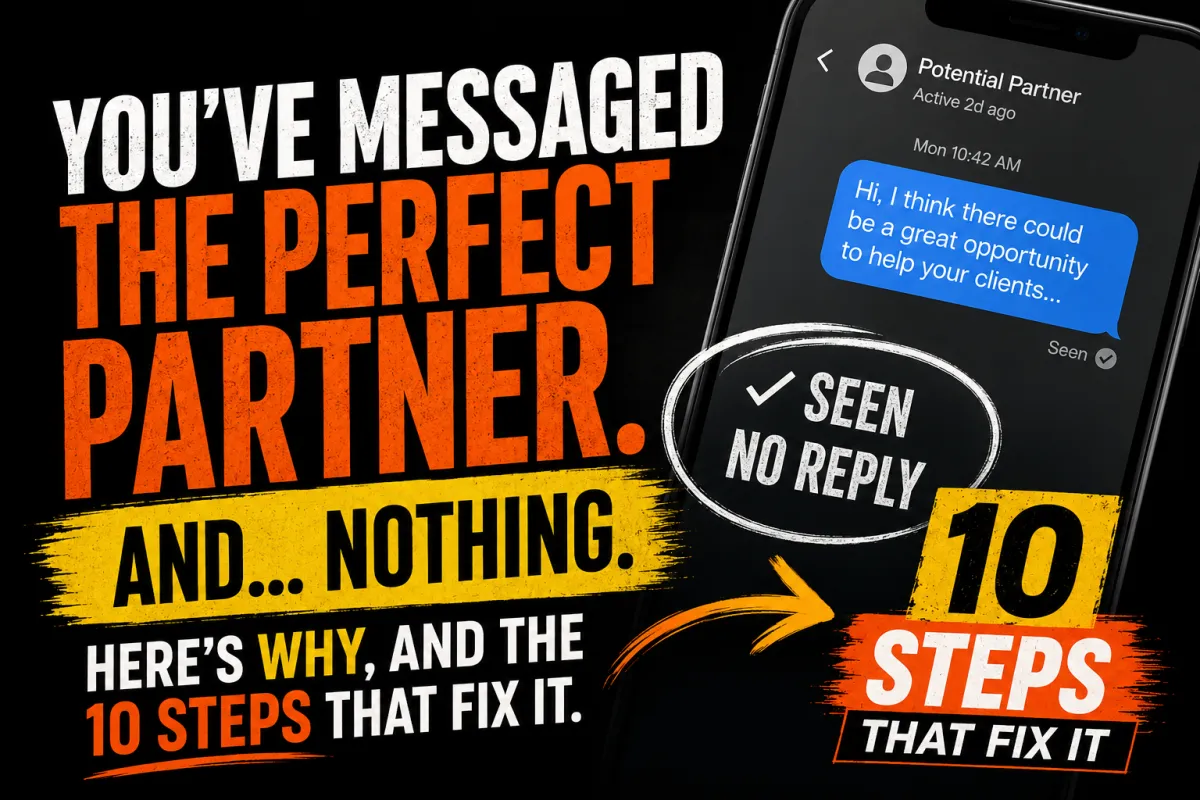
You Messaged the Perfect Strategic Partner. Here's Why They Never Replied (10 Steps to Fix It)
You've Found the Perfect Strategic Partner. You've Messaged Them. And... Nothing.
You've found the perfect strategic partner. Your clients overlap. The value add is obvious, at least to you. You send the message.
........
And then, nothing.
[Watch the YouTube in the link at the bottom]
If that's happened to you, the problem usually isn't the partnership idea. It's the process behind the ask. Here are the 10 steps that actually get a strategic partner meeting booked, with a closer look at the three that make the biggest difference: finding a warm connector, choosing the right channel, and following up properly.
The Core Principle: Make Saying Yes Easy
Before the 10 steps, one idea sits underneath all of them. The goal of your first message isn't to sound impressive. It's to make saying yes the easiest thing the other person does that day. Every step below exists to remove friction, and to make the value of the conversation obvious before they've even replied.
The 10 Steps
Identify the right target. Someone whose clients genuinely overlap with yours, not just someone in an adjacent industry. Usually businesses are connected to many other businesses, the idea is not to see these as competitors, but value enhancers. Think web designer / marketing agency or... Accountant / Tax advisor
Spend five minutes on research. What do they post about, who do they serve, what have they said publicly about their clients' problems. This works at the start to ensure you are hitting the right areas, once you scale using tools to support this is advised.
Find a warm connector if one exists. Or better still reverse engineer this process, and find the people and organisations you are already to connected with...
Write your credibility line first. One sentence, before you write anything else.
Build the ask around their clients, not you. "There could be a quick win for your clients" adds far more value than "I'd love to pick your brain." THE IMPORTANT ITEM HERE IS: VALUE, Value for the client! Put that at the front of your mind here...
Choose the right channel for them.
Keep the message short. Four or five sentences maximum.
Give two specific time options. Remove the decision-making effort entirely.
Follow up once, with something new. Follow in B2B outreach is essential. Remove interference and automate it with special tools like Glow Framework... Strategic Accelerator...
Send a one-line agenda before the meeting, so it starts on the front foot before you've said hello.
Step 3, In More Detail: The Warm Connector
This is the step most people skip, and it's usually sitting right in front of them.
You'll already be connected to more potential partners than you think, through the cross-over services that naturally combine with your own. If you're requesting documents from clients, for example, you're probably already in touch with their accountants. If you're a marketing agency, you're likely already working alongside web designers on the same projects. These crossover points are strategic partnerships waiting to happen, and a warm connector inside them is worth more than any cold message you'll ever send.
The practical step here is to actually build the list. Go through your recent projects and client work, and write down every professional you've crossed paths with in a complementary service. That list is very likely your first five strategic partner conversations, already half-warm before you've sent anything.
Step 6, In More Detail: The Right Channel
Email still has its place, and a lot of the process around it can be automated, sourcing addresses, sending the first message, scheduling the follow-up. But that's exactly why it's no longer a point of difference. Everyone's inbox is full of automated outreach.
The real point of difference today is showing up in person, and doing the things that can't be automated. A handwritten note lands differently to an email, because the effort is visible. Being physically present, at an event, in their office, at a relevant meetup, does more for credibility in one interaction than a dozen automated messages ever will. Here we should adopt the philosophy of
"Support front and back end with automation tools, but keep in person as the real point of difference"
That doesn't mean abandon email. It means treat it as the efficient channel for reach, and treat the personal, visible channel as the one that actually builds trust and adds value to the relationship. Use both, deliberately, rather than defaulting to whichever is easiest.
Step 9, In More Detail: Follow Up, Follow Up, Follow Up
In professional B2B relationship-building, not getting a response straight away is completely normal. Don't read it as a rejection, read it as part of the process.
Most potential partners are busy, not uninterested. A follow-up that adds something new, a relevant example, a small piece of value, a useful update, keeps the door open without becoming a nuisance. The mistake isn't following up. The mistake is following up with nothing new to say.
Build follow-up into your process as a standard step, not an afterthought you only do if the first message feels like it's worth chasing. Every strategic partner conversation that eventually adds real value to both sides usually took more than one message to get there.
Does This Make Sense for You?
Before you send anything, it's worth asking the bigger question underneath all 10 steps: does it make sense for us to build a strategic partnership here, one that genuinely adds value to both sides, and to their clients? If the answer's yes, these steps are how you get the meeting. If it's unclear, that's exactly what the meeting itself is for, to find out.
This post accompanies the video "You've Found the Perfect Strategic Partner. You've Messaged Them. And... Nothing." part of a weekly series on building strategic partnerships. New video and blog post every Monday.