

How many marketing strategies does a small business need?
How many marketing strategies does a small business need?
By Phil Ball, business coach for UK founders and SME owners
TL;DR
One marketing strategy is a hobby. A business that relies on one source of leads is one bad quarter away from a quiet pipeline.
Aim for at least 8 strategies running consistently, chosen from the 12 in the Small Business Marketing System.
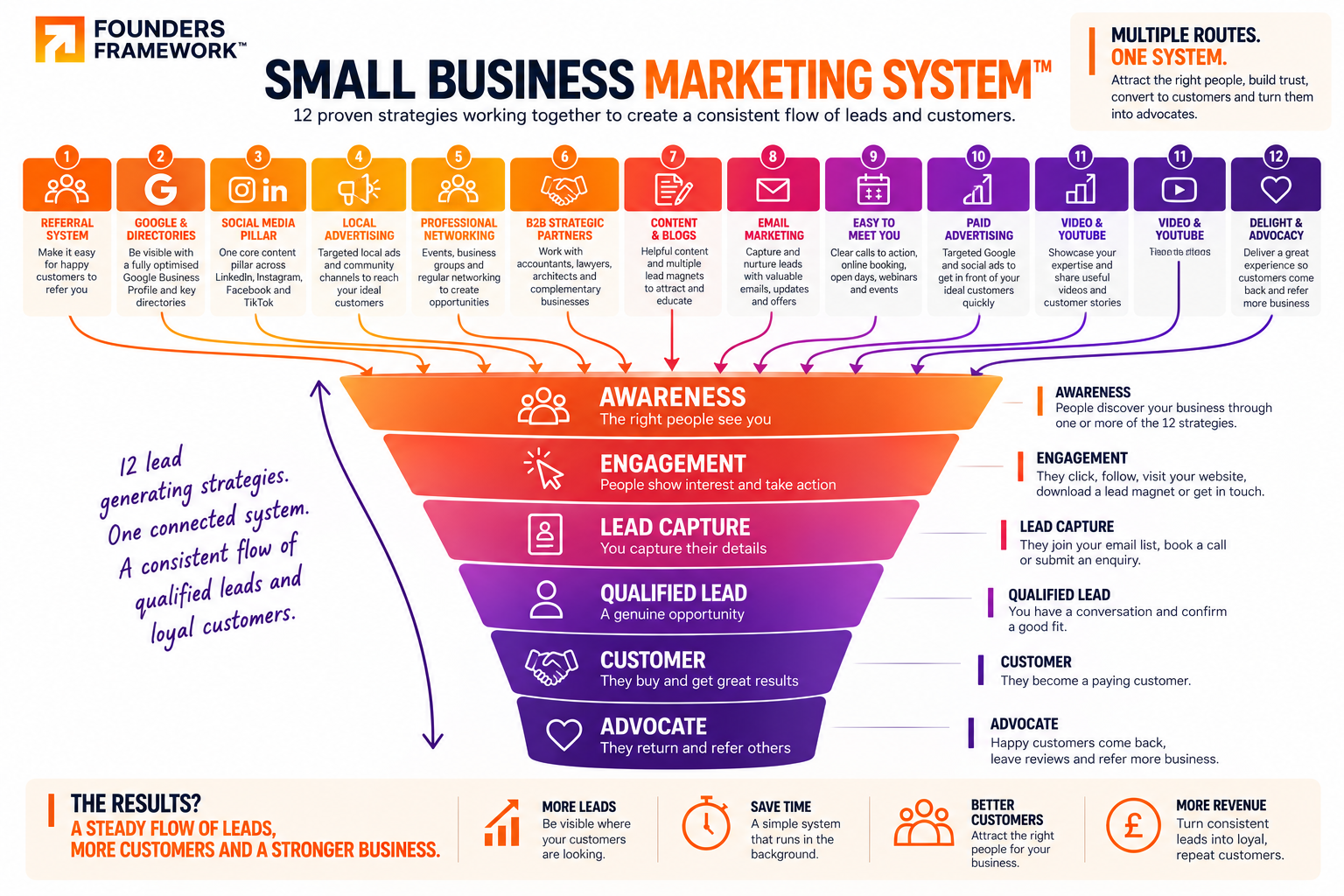
The strategies feed one system: awareness, engagement, lead capture, qualified lead, customer, advocate.
Choose your strategies through MSOFT. Marketing can only grow as fast as your sales, operations, finance and team can handle.
[Scroll to the bottom for You Tube Video]
Why is one marketing strategy not enough?
One marketing strategy is not enough because at any moment most of your potential customers aren't ready to buy, and the ones who are use several channels before they decide. A single strategy reaches a small slice of the market once. Several strategies reach more of the right people, more often, so you're the obvious choice when they're ready.
Two pieces of research explain why. The LinkedIn B2B Institute, working with the Ehrenberg-Bass Institute, estimates that only 5% of B2B buyers are in market at any given time; the other 95% won't buy for months or years (Marketing Week, 2021). And McKinsey's B2B Pulse survey found that business buyers now use an average of 10.2 channels in their buying journey, up from five in 2016 (McKinsey B2B Pulse, 2024).
Put those together and the problem with one strategy is clear. If you only get work from referrals, you're invisible to the 95% who aren't asking for a recommendation yet, and you're missing from most of the channels buyers check before they get in touch.
What are the 12 strategies in the Small Business Marketing System?
The Small Business Marketing System is 12 lead-generating strategies that work together to create a consistent flow of leads and customers. They range from free and relationship-based (referrals, networking, partners) to paid and fast (local and online advertising). Most businesses I meet are running one or two of them properly.
# | Strategy | What it means in practice |
|---|---|---|
1 | Referral system | Make it easy for happy customers to refer you, and ask at the right moment rather than hoping. |
2 | Google and directories | A fully optimised Google Business Profile and listings in the directories your customers use. |
3 | Social media pillar | One core piece of content each week, cut down for LinkedIn, Instagram, Facebook and TikTok. |
4 | Local advertising | Targeted local ads and community channels that reach your ideal customers where they live and work. |
5 | Professional networking | Events, business groups and regular networking where relationships turn into opportunities. BNI is a great place to join |
6 | B2B strategic partners | Working with accountants, lawyers, architects and complementary businesses who already serve your ideal client. |
7 | Content and blogs | Helpful articles and lead magnets that attract and educate buyers before they speak to you. |
8 | Email marketing | Capturing leads and keeping in touch with useful emails, updates and offers until they're ready. |
9 | Easy to meet you | Clear calls to action, online booking, open days, webinars and events. |
10 | Paid advertising | Targeted Google and social ads that put you in front of your ideal customers quickly. |
11 | Video and YouTube | Showing your expertise with useful videos and customer stories. Marcus Sheridan is a guru on this, follow his steps for first 7 videos |
12 | Delight and advocacy | A customer experience good enough that people come back and refer more business. |
How do the 12 strategies work together?
The 12 strategies all feed one funnel with six stages: awareness, engagement, lead capture, qualified lead, customer and advocate. Each strategy has a job at one or more stages. The system works when every stage has something in it, so a new contact moves from first seeing you to buying and referring others.
Awareness: the right people see you, through any of the 12 strategies.
Engagement: they click, follow, visit your website or download something.
Lead capture: you capture their details, through your email list, a booked call or an enquiry form.
Qualified lead: you have a conversation and confirm it's a good fit.
Customer: they buy and get great results.
Advocate: they come back, leave reviews and refer more business, which feeds awareness again.
This is why the last strategy, delight and advocacy, matters as much as the first. Your happiest customers start the next loop of the funnel for free.
Why should you aim for at least 8 strategies?
Aim for at least 8 strategies because that's roughly the point where your lead flow stops depending on any single source. With 8 running, a quiet month on one channel is covered by the others, you appear in enough of the places buyers check, and you can see which strategies give the best return.
Eight is a target to build towards, not a starting line. Add one strategy at a time, and only count it as "running" when it has three things written down:
An owner: the person responsible for it each week (it doesn't have to be you).
A frequency: how often it happens, such as one partner coffee a week or one email a fortnight.
A target: the number you'll track, such as enquiries, booked calls or introductions.
A strategy without those three is a good intention. One strategy is a hobby; eight with owners and targets is a marketing system.
Where do strategic partners fit in your marketing?
Strategic partners fit as one strategy out of 12, but often the one with the highest return for B2B service businesses. A good partner, such as an accountant, solicitor or complementary trade, already has the trust of your ideal clients. One introduction from them is worth more than dozens of cold contacts.
Partners also strengthen the other strategies. A partner can share your content, co-host an event, mention you in their email and send referrals that become your next advocates. That's the point of a system: each strategy makes the others work harder.
As a business coach I work with networks that look after a lot of businesses and also accountants that want to help their clients grow. These form trusted introductions for us here at founders framework.
If you want to go further on partners, my earlier videos and blogs walk through how to find, approach and grow strategic partnerships step by step. Read them on the blog.
How should MSOFT shape which marketing strategies you choose?
Choose marketing strategies your business can actually handle, which is where MSOFT comes in. More leads only help if your sales process converts them, operations can deliver the work, finance can fund the activity and your team has someone to run it. Marketing that outpaces the other four creates stress, not growth.
Sales: do you follow up every enquiry on a schedule? If not, fix that before you add paid ads, or you'll pay for leads that leak away.
Operations: can you deliver more work without quality dropping? If capacity is tight, start with slower, relationship-based strategies like partners and referrals.
Finance: what can you invest each month, and how long can you wait for a return? Paid advertising is fast but costs money from day one; content and networking cost time.
Team: who will own each strategy? If the answer is always you, pick fewer and build up.
Marketing is the only growth lever with no ceiling, but the other four set how fast you can safely push it.
How do you get started this week?
Start by counting how many of the 12 strategies you have running properly today, with an owner, a frequency and a target. Then pick one to add this month, choosing the one that fits your current MSOFT position. Write it down, give it a weekly slot in your diary and review it after 90 days.
Score yourself: which of the 12 are running consistently right now?
Check your MSOFT: is sales follow-up solid enough to handle more leads?
Pick one new strategy, and set its owner, frequency and target.
Review in 90 days, keep what works, and add the next.
If you'd like help working out where to start:
Take the quiz to see where your business stands.
Marketing for Busy Founders, my mini course, walks you through building your system.
Or email me at [email protected] to book a time in my diary.
Frequently asked questions
How many marketing strategies should a small business have?
Aim for at least 8 running consistently, each with an owner, a frequency and a target. Build up to that one strategy at a time rather than starting all at once.
Which marketing strategy is best for a B2B service business?
Referrals and strategic partners usually give the best return early on, because they borrow trust that already exists. They work best alongside a Google Business Profile, content and email, so buyers can find and check you.
Is word of mouth enough to grow a business?
It can keep a business going, but it's hard to grow on, because you can't control when referrals arrive. A referral system that asks at the right moment is more reliable than waiting. Many great businesses start with this method, and it quickly becomes a full time job, nailing your marketing lead generation will set you apart from the competition and enable you the time to scale and hire a team!
Should I start with paid advertising?
Only if your sales follow-up is solid and you can afford to test for a few months. Otherwise you'll pay for leads you don't convert. Remember every change you make to your ads then requires "testing" phase, this is valuable time and money that could be invested elsewhere for now.
How long before a new marketing strategy works?
Give each strategy 90 days of consistent activity before you judge it. Relationship strategies like partners and networking often take longer to pay back, and pay back for longer. Again with clients we track numbers weekly, and we ensure we test and measure all results. Make sure you TEST your marketing!