
What Happens After the First Meeting? The Follow-Up Process Most People Get Wrong
What Happens After the First Meeting? The Follow-Up Process Most People Get Wrong
TL;DR
A good first meeting isn't a result, it's just qualification. Send your follow-up within 24 hours, structure it around three parts (acknowledgement, a piece of value, one dated next step), and state your expectations openly. Skip any of these and you fall into the "went well, then silence" trap, which is the single biggest reason UK SME referral partnerships never produce a lead.
What Should You Do Immediately After a First Partnership Meeting?
Send a follow-up message within 24 hours that names one specific, dated next step, not a vague "let's stay in touch." A good first meeting only confirms there's a fit; it isn't a result on its own. The partnership itself starts with what happens in the 24;48 hours afterwards.
This is where most business owners quietly drop the ball. They leave the meeting feeling good, assume the warmth will carry the relationship forward, and move on to the next task on their list. Three weeks later, neither side has done anything, and both are quietly assuming it's the other person's move.
Treat the meeting as stage 4 of the process, "Discover & Add Value," not the finish line. Stages 5 and 6, building trust and creating a referral pathway, only happen in what you do next.
Why Does the "Went Well, Then Silence" Trap Kill So Many Partnerships?
Because nobody owns the next action, both sides default to inaction, and the relationship cools before it's ever tested. It's the same pattern I see inside the trade and service businesses I coach, UK Businesses where quote conversion typically sits at 30-35% before we fix anything (A lot of businesses don't even know that number in their own business). The gap between a quote sent and a quote won is almost never about price. It's about what happens (or doesn't) in the days after the conversation. A first partner meeting has the exact same failure point.
It's worth being blunt about this: a warm conversation creates a feeling of progress without creating any actual progress. Nothing has been agreed, nothing has a deadline, and nothing distinguishes this contact from the dozens of other "nice chats" both of you have every month. Without a structured next step, goodwill has a shelf life of about a week before it starts to fade.
The fix isn't more charisma in the meeting. It's a follow-up process you run the same way every time, so the outcome doesn't depend on memory or motivation.
What Should Your Follow-Up Message Actually Say?
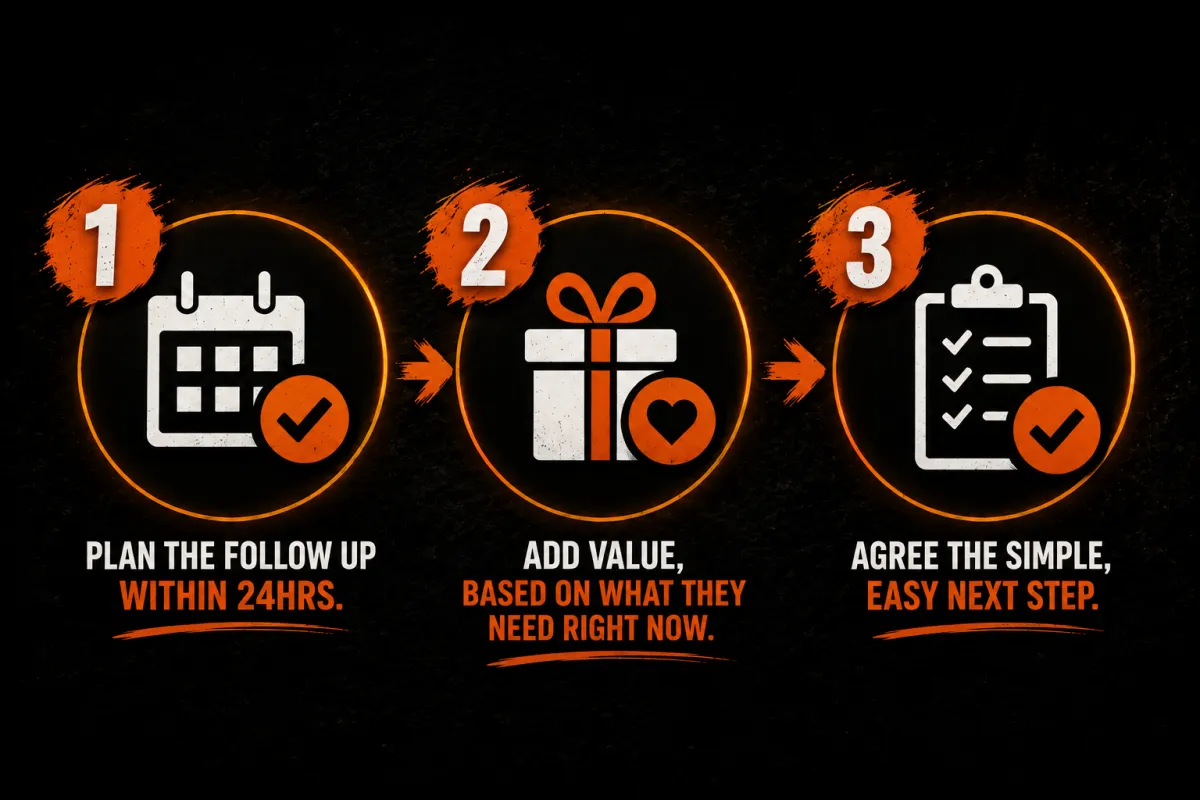
A strong post-meeting follow-up has three parts: a specific acknowledgement, one piece of value with no ask attached, and a single dated next step. Skipping the value and going straight to the ask is the fastest way to make a new partner feel like a prospect rather than a peer.
Here's what that looks like in practice:
Specific acknowledgement: reference something they actually said, not a generic "great to meet you." This signals you were listening, not performing a script. For example: "The point you made about how your fire alarm clients keep getting stung on reactive callouts really stuck with me."
One piece of value, no strings attached: a relevant resource, a client intro, or a useful insight about their market. This is the "add value before you ask for anything" principle in action, and it's what separates a strategic partner from a networking contact.
One dated next step: not "let's keep in touch," but something concrete: "I'll send you three names of clients who'd be a good fit for your service by Friday." A next step without a date is a suggestion. A next step with a date is a commitment.
How Do You Set Expectations With a Strategic Partner?
At this stage we are aligning the value to our clients and their clients we are looking for natural ways it could cross over. We are making notes on how it could work, we are not locking it in, until we have more information and commitment from them.
If it was a really positive meeting then you can consider the following; Assume the beginnings of a partnership exists. Name expectations early and make a partner trust you're serious rather than just being polite. It also gives you a clean way to spot, early, whether the other person is actually going to reciprocate or whether this was a one-off nice conversation.
What Does a Simple Post-Meeting Follow-Up Process Look Like?
A repeatable process beats a one-off great email every time. Here's the cadence worth building into your CRM or diary:
Timing Within 24 hours
Action Send the three-part follow-up: acknowledgement, value, dated next step
Day 7-14 Deliver on whatever you committed to, then check in briefly
Day 30 Review: has anything moved? If yes, formalise a referral pathway. If no, decide whether to keep nurturing or deprioritise
Ongoing Stay visible with occasional, genuinely useful contact, not sales pressure
This is deliberately simple. Complexity is what kills follow-up systems in practice: if it takes more than a couple of minutes to know what to do next with a given partner, most business owners won't do it consistently, and consistency is the entire point.
Frequently Asked Questions
How quickly should I follow up after a first partnership meeting? Within 24 hours. Speed signals reliability, which is exactly the quality a potential partner is quietly assessing you on in this early stage. It matters more than the polish of the message itself.
What if the other person doesn't reply to my follow-up? Give it a week, then send one more short, value-led touch, not a chaser asking why they've gone quiet. If there's still no response after two attempts, deprioritise them rather than chasing indefinitely; not every good meeting becomes a partner.
Should I ask for referrals in the first follow-up? No. The first follow-up should add value and propose a next step, not ask for anything. Asking too early is the quickest way to make a potential partner feel like a lead rather than a collaborator.
How do I know if someone is a real partner rather than a one-off contact? A real partner reciprocates: they respond to your follow-up, engage with the value you send, and are willing to agree on how referrals will work. If that reciprocity isn't there after a couple of touches, it isn't a partnership yet, and may never be.
Building a proper partner and referral channel rather than relying on one-off intros? This is exactly the kind of system we build inside Founders Framework