
Why counting referrals from a strategic partner isn't enough
TL;DR
Referral count on its own is misleading, a partner can send five referrals and none of them fit your ideal client. Score every referral 1 to 5 on quality, meaning how well it matches who you're actually built to serve, not whether it converted. A partner sending two well-matched referrals is worth more than one sending five that don't fit, and the score is what shows you the difference.
Why Referral Count On Its Own Is Misleading
A partner who sends you five referrals a quarter looks like your best partner, until you notice none of the five were the right fit and none converted. Counting referrals measures activity, not value. Two partners can produce the same number on paper while one is genuinely building your business and the other is quietly wasting your time on unqualified leads.
What Does "Referral Quality" Actually Mean?
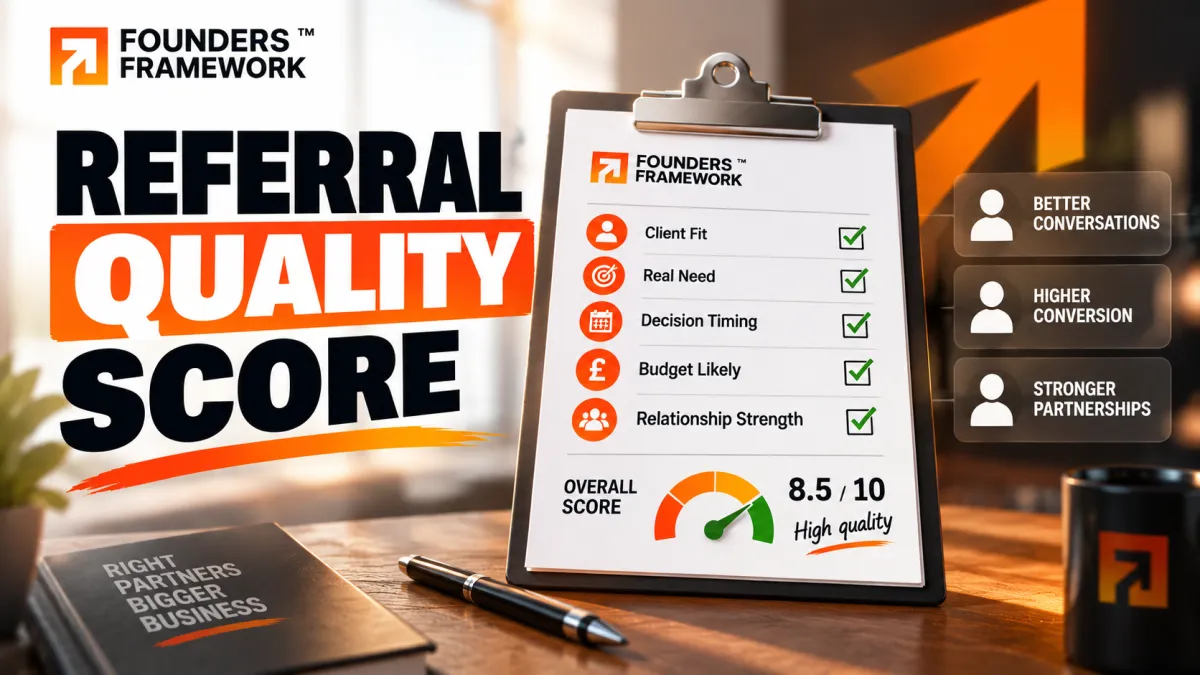
Referral quality means how closely a referral matches your ideal client, not whether it went on to become a paying customer. A referral can be a perfect fit and still not convert for reasons that have nothing to do with the partner, and a referral can convert by luck despite being a poor fit. Scoring on fit, not outcome, is what makes the number reliable.
How Do You Score a Referral's Quality?
Use a simple 1 to 5 scale, applied to fit rather than result:
1, Not a fit: wrong type of client entirely, a wasted introduction.
2, Weak fit: right industry, but wrong stage, budget, or need.
3, Workable fit: matches most criteria, missing one key factor, usually budget or urgency.
4, Strong fit: matches your ideal client closely, right timing and budget.
5, Perfect fit: exactly your ideal client, ready to move, all it needed was the intro.
Score every referral as it comes in, while the context is fresh, rather than trying to reconstruct it at the end of the quarter.
How Should You Use a Quality Score?
Use it to decide where your time goes. A partner consistently scoring 4s and 5s deserves more of your attention, more introductions back, and a deeper relationship, even if the volume is low. A partner consistently scoring 1s and 2s isn't adding value no matter how often they refer, and the volume can actually be a distraction from that fact. The score turns "this partner sends me a lot" into "this partner sends me the right people," which is the number that actually matters.
Where Should You Track It?
Log the score against every referral, per partner, as part of your regular partnership review, not as a one-off exercise. Tracked over a full quarter, the average score per partner tells you far more about a relationship's real value than the raw referral count ever will.
Download your scorecard: https://docs.google.com/spreadsheets/d/1QoSHnb1eaIGqdTfD4Ou7F6l8IUnFr9ZVd1LV4GaCiVc/copy
FAQ
Why isn't counting referrals from a strategic partner enough?
Because it measures activity, not value. A partner can send several referrals that don't match your ideal client, which looks productive on paper but doesn't actually grow the business.
How do you score the quality of a referral?
On a 1 to 5 scale based on how closely it matches your ideal client, not on whether it converted: 1 is not a fit at all, 5 is a perfect fit ready to move.
Should conversion rate be the main way to judge a referral partner?
No. Conversion depends on factors outside the partner's control. Scoring fit at the point the referral is made gives a more reliable picture of how well a partner actually understands who you serve.