
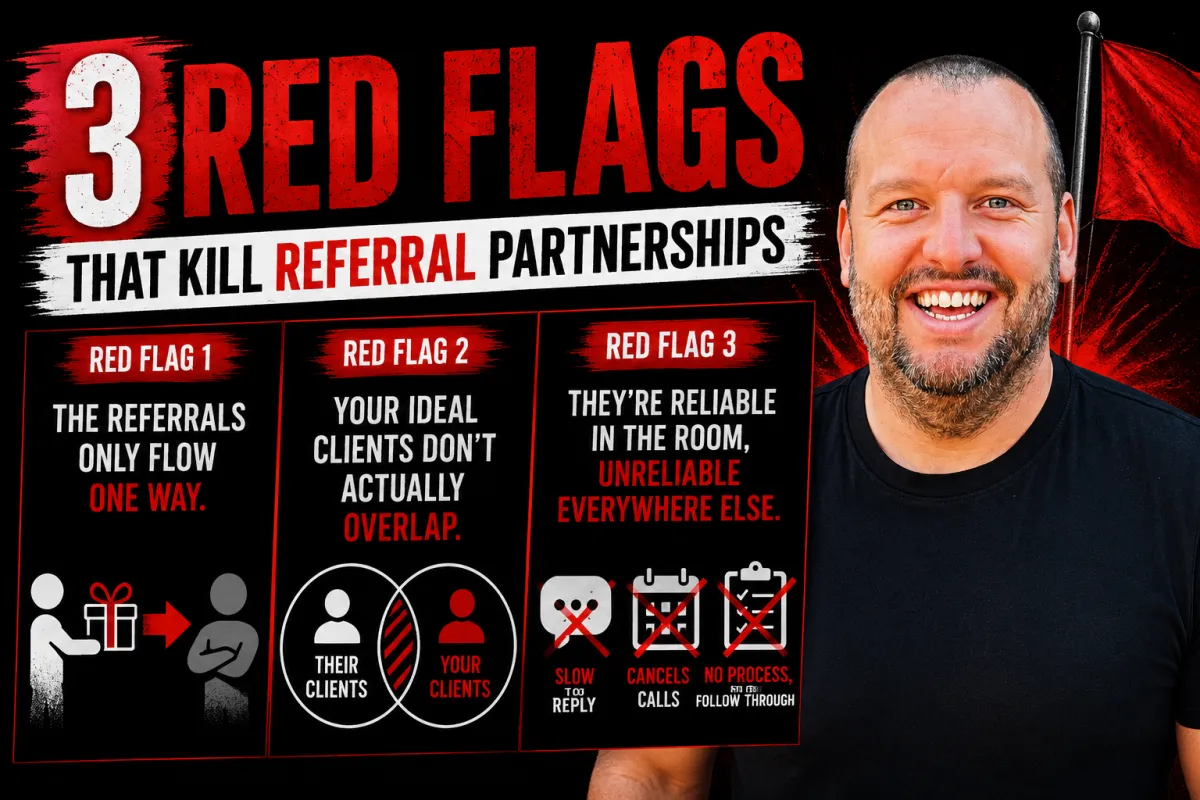
3 Red Flags That Mean This Strategic Partner Isn't Worth It (And How to Test One in 90 Days)
3 Red Flags That Mean This Strategic Partner Isn't Worth It (And How to Test One in 90 Days)
TL;DR
Red Flag 1: Referrals o
nly flow one way you give, they don't give back.
Red Flag 2: Your ideal clients don't genuinely overlap, however well you get on personally.
Red Flag 3: They're reliable face-to-face but unreliable everywhere else, no follow-through, no process.
The fix: Test any new partner for 90 days against these three before investing real time most SME owners can spot a dud partnership by week 6 if they know what to look for.
What Makes a Strategic Partner Actually Worth Your Time?
A strategic partner is worth your time when referrals move in both directions, your ideal clients genuinely overlap, and they follow through consistently, not just when it's convenient. Most business relationships that get called partnerships never clear this bar. They stay stuck as pleasant introductions that never turn into a real, mutual referral pipeline.
That distinction matters because time spent nurturing the wrong "partner" is time not spent on the ones who'd actually move the needle, introductions, follow-ups, coffee meetings, LinkedIn messages, all of it. For a busy SME owner already juggling delivery and sales, that's not a small cost.
Red Flag #1: The Referrals Only Flow One Way
If you've sent a partner several referrals and received none back after a fair amount of time, that's not a slow start, it's the actual pattern, and it means the relationship isn't a partnership, it's a one-sided favour.
This is the flag I see most often with service business owners, fire & security firms, facilities management companies, electrical and renewables contractors. These owners tend to be generous by instinct, so they refer first and assume reciprocity will follow. Often it doesn't, because there was never a defined referral process on the other side to make it happen, no clear pathway, no expectation set, nothing tracked.
How to spot it early: After your third referral sent with nothing returned, raise it directly. A genuine partner will either reciprocate quickly or acknowledge the gap. Silence, deflection, or vague promises are your answer.
Red Flag #2: Your Ideal Clients Don't Actually Overlap
A strategic partnership only works commercially if your two client bases genuinely overlap, not if you simply enjoy each other's company or respect each other's work. Personal rapport is a poor substitute for ideal client fit, and it's the single most common reason referral relationships fail to convert.
This is the sneaky one, because it feels right before it's tested. In coaching sessions with SME owners across the £500k to £1.5m turnover range, I regularly hear versions of the same complaint: ten "partner" meetings for one usable referral. The relationship felt productive because the meetings were enjoyable, but nobody had actually mapped whether their client bases matched. This is due to poor questions at the start and really nailing down professional expectations early on.
How to spot it early: Ask your prospective partner to walk you through their last three clients in real detail, sector, size, problem solved. If you can't picture your own ideal client anywhere in that description, the fit isn't there, no matter how well the meeting went.
Red Flag #3: Reliable in the Room, Unreliable Everywhere Else
If a partner is engaged and articulate in meetings but consistently slow to reply, cancels calls, or forgets agreed actions, that inconsistency will show up exactly when it matters most, when they need to actually hand you a warm referral.
This is the flag owners forgive longest, because the person seems genuine and likeable in person. But partnerships run on operational reliability, not charm, the same trust markers that make someone a good referral source (credibility, consistency, low self-interest) are the ones missing here. Someone who can't close the loop on a simple email won't close the loop on something that costs them more, like introducing you to their best client.
How to spot it early: Track the small commitments over the first month, replying to messages, showing up on time, closing agreed actions. Treat this as diagnostic data, not a character judgement made after one good meeting.
How to Test a New Partner in the First 90 Days
Rather than committing months of relationship-building to a partner who was never going to reciprocate, run a structured 90-day test before investing real time:
Weeks 1–2: Have the discovery conversation. Map their actual client base against yours in detail, don't rely on impressions. Ask them who their ideal client is? What are they buying, where do they come from? Ask about their processes.
Weeks 3–6: Send 1 to 3 genuine referrals. Note whether anything comes back, and how quickly they follow up on what you've sent. Even if nothing comes back right away but they are showing clear signs of being proactive that makes a difference. You will need to make it really simple for them to mention you, so that will depend on what you give them to use. Have a look at partnership asset creation in the YouTube channel.
Weeks 7–12: Review reliability on the small stuff, replies, meetings kept, actions closed. Then decide: invest further up the partnership ladder, or step back gracefully.
If a partner clears all three checks, that's exactly the point to start building something more structured together, a defined referral process, shared resources, joint content, rather than leaving it as another pleasant but unproductive contact.
FAQs
What's the biggest sign a referral partnership isn't working? The clearest sign is one-way referrals, you're consistently sending business their way with nothing coming back after a fair number of attempts, despite early promises of reciprocity.
How long should I give a new strategic partner before deciding? Around 90 days is usually enough to see a genuine pattern, long enough for a few referral exchanges and several small commitments to test reliability, but short enough that you haven't over-invested if it isn't working.
Can a partnership work if we don't have identical client bases? Yes, but the client bases need to genuinely overlap on your ideal client, not just share a similar market. Complementary, non-competing businesses solving different problems for the same client type is the strongest fit.