

How do referral partnerships fit into a small business marketing plan?
How do referral partnerships fit into a small business marketing plan?
By Phil Ball, business coach for UK founders and SME owners
TL;DR
Strategic referral partners are one of the 12 strategies in a small business marketing system, and often the one with the best return for B2B service businesses.
Referred customers have been found to be worth 16–25% more over their lifetime than other customers.
Partners can help at every stage of your funnel, from awareness to advocacy.
Start with two or three partner types whose clients match yours, add value before asking for anything, and check your business is ready to handle the referrals.
What is a strategic referral partner?
A strategic referral partner is a business that serves the same clients as you but solves a different problem, so you can recommend each other without competing. For a commercial electrician, that might be a facilities manager or a building surveyor. For an IT company, it might be an accountant who sees every client's systems at year end.
The value of a partner is borrowed trust. When someone a client already relies on recommends you, the client skips the stage of wondering whether you're any good. For a fuller introduction, read What Is a Strategic Partner? A Simple Guide for Business Owners.
Where do referral partners fit in a marketing plan?
Referral partners fit as one strategy within a wider marketing system, not as the whole plan. In my Small Business Marketing System they're strategy 6 of 12. They work best alongside a Google Business Profile, content and email, so that when a partner recommends you, the client can find you, check you out and stay in touch.
As I covered in How many marketing strategies does a small business need?, one strategy is a hobby and you want at least eight running. Many owners treat referrals as their only strategy, but rely on them passively. A partner strategy is different: you choose who to work with, approach them on purpose and build a process for referrals to flow both ways providing VALUE to the customer is at the core of both companies!
Why are referred clients worth more?
Referred clients are worth more because they arrive already trusting you, which tends to mean better margins and longer relationships. A study of almost 1,800 referred customers, published in the Journal of Marketing Research, found their lifetime value was 16–25% higher than that of customers acquired in other ways (Van den Bulte et al., 2018, via the American Marketing Association).
The same research found something worth knowing: referred customers stayed loyal as long as the person who referred them stayed. If the referrer left, the referred customer became as likely to leave as anyone else. The lesson for partnerships is clear. Look after the partner relationship, not only the client.
How do partners help at each stage of the marketing funnel?
Partners help at every stage of the funnel, which few other strategies do. They create awareness with people who'd never find you online, pass on leads that are already qualified because the partner knows both sides, and their clients often become your advocates. One good partner can do the work of several separate strategies.
Funnel stage | How a strategic partner helps |
|---|---|
Awareness | Mentions you to clients who would never have found you through search or social media. |
Engagement | Shares your content, or co-hosts an event or webinar with you. |
Lead capture | Makes a direct introduction, so the lead arrives with a name, a need and a reason to talk. |
Qualified lead | Filters for fit before introducing, because they know both you and the client. |
Customer | Adds credibility during the sale ("I've worked with them for years"). |
Advocate | A referred client who gets a great result often refers the next one. |
Timing matters too. Research by the LinkedIn B2B Institute suggests only about 5% of B2B buyers are in market at any time (Marketing Week, 2021). Partners talk to the other 95% every week, so they're often in the room when a client becomes ready to buy.
Which types of business make the best referral partners?
The best referral partners are businesses whose clients look like yours and who are in regular, trusted contact with them. I work through 10 types with clients, from accountants and industry networks to employers. You don't need all ten. Start with the two or three whose client lists overlap most with your ideal client.
Professional services: accountants, bookkeepers and consultants who work closely with business owners.
Industry networks and associations: connections who already have access to your target market.
Local businesses (non-competing): complementary businesses serving the same ideal clients.
Service providers: legal, IT, marketing and HR providers solving different problems for the same clients.
Existing clients and advocates: happy clients who can introduce you to others.
Community organisations: local groups, chambers of commerce and community initiatives.
Education and training providers: colleges, trainers and coaches with access to your audience.
Health and wellbeing professionals: experts who often work with your target market.
Online communities and influencers: people with audiences that trust their recommendations.
Corporate partners and employers: businesses that need your service for their teams or clients.
For example we have just partnered with a local accountancy firm that want to do 2 things, educate their clients on marketing strategies, and also provide advice and guidance to the founders framework members.
How do you approach a potential referral partner?
Approach a potential partner by offering value first, not by asking for referrals. Research their business and clients, make a warm, personal approach, and use the first conversation to learn what their clients need. Referrals follow once they trust you and know exactly who to send.
I use a seven-stage process with clients:
Identify and prioritise partners by fit, influence and referral potential.
Research and personalise so your approach shows you understand their world.
Outreach and open the door by email, LinkedIn or a mutual introduction, aiming for a short discovery call.
Discover and add value by sharing insights or resources, with no hard sell. The focus here is to understand exactly how they add value to their clients and finding out what problems they solve.
Build the relationship and trust by staying in touch and being useful.
Create a clear referral pathway so it's easy and low-risk for them to refer you.
Activate, nurture and scale by thanking them, sharing outcomes and growing the relationship.
How do you grow a referral partnership over time?
Grow a referral partnership by moving beyond introductions to creating value together. The Partnership Value Ladder has seven steps, from basic introductions to a full strategic alliance. Each step builds trust, makes you harder to replace and increases how often referrals arrive.
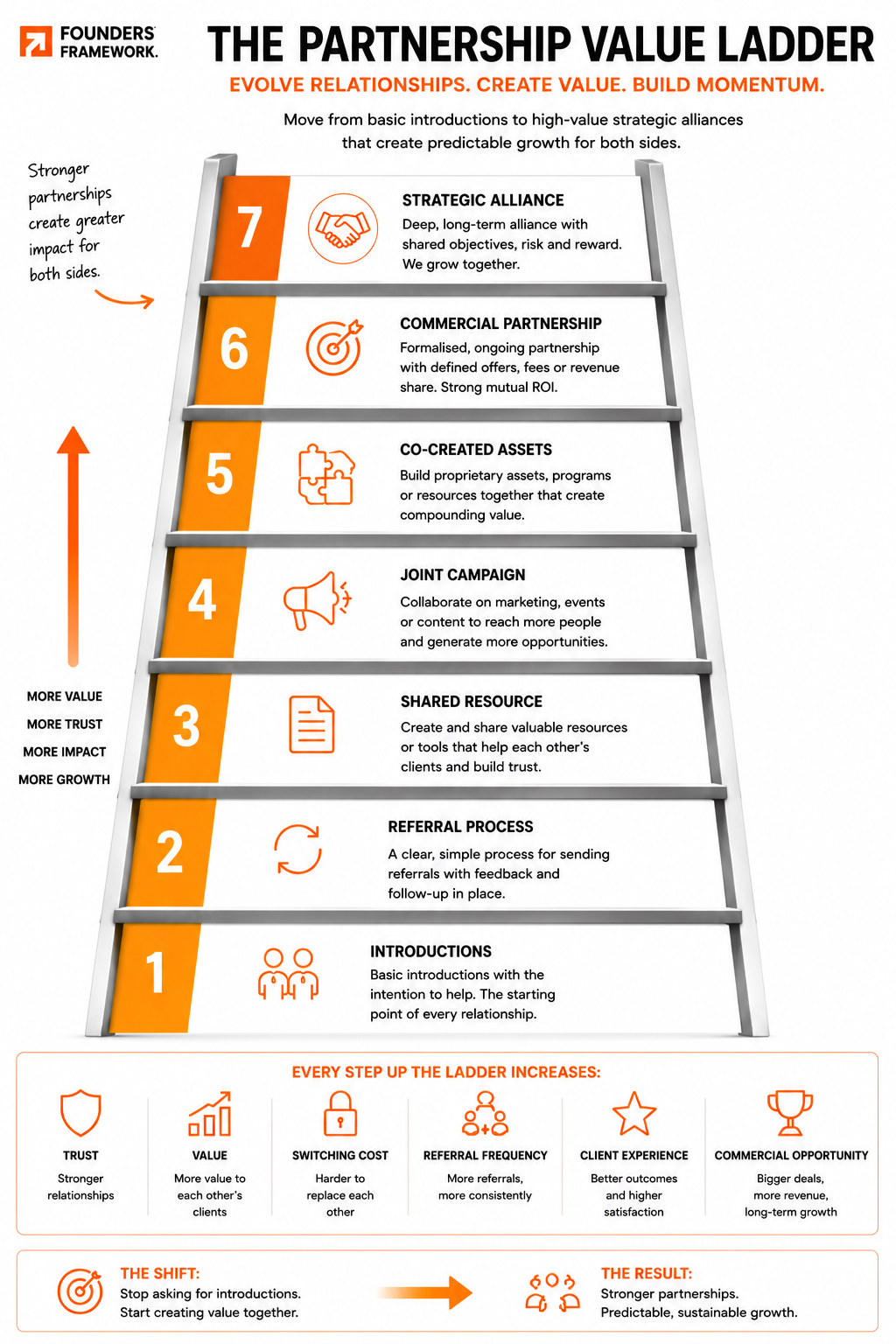
Introductions
Referral process, with feedback and follow-up
Shared resource that helps each other's clients
Joint campaign, such as an event, webinar or content
Co-created assets or programmes
Commercial partnership with defined offers, fees or revenue share
Strategic alliance with shared objectives, risk and reward
The shift is simple: stop asking for introductions and start creating value together.
Is your business ready for referral partners?
Your business is ready for referral partners when your sales, operations, finance and team can look after referred clients well. A partner who refers you is lending you their reputation. If the client gets a slow response or a poor experience, you won't get a second referral. Run the MSOFT check before you start.
Sales: can you respond to every referral within 24 hours?
Operations: will a referred client get a great experience that makes your partner look good?
Finance: have you agreed how you'll thank partners, whether through referral fees, reciprocal referrals or both?
Team: is there a named owner for each partner relationship?
What should you do this week?
This week, write down three businesses that serve your ideal client but don't compete with you, then book a coffee with one. Go to learn about their clients, not to ask for referrals. That single conversation is the first step on the Partnership Value Ladder.
Take the MSOFT Scorecard to see how your marketing, and the rest of your business, scores out of 100.
Marketing for Busy Founders walks you through building your marketing system.
Or email me at [email protected] to book a time in my diary. https://api.leadconnectorhq.com/widget/bookings/phil-ball
Frequently asked questions
What is the difference between a referral partner and a strategic partner?
A referral partner sends you introductions. A strategic partner goes further, working with you on shared resources, joint campaigns or commercial offers. Most strategic partnerships start as referral partnerships and grow up the Partnership Value Ladder.
Should I pay referral fees to partners?
It depends on your industry and margins. Some partners prefer a fee, others prefer reciprocal referrals or simply knowing their client will be looked after. Agree it openly at the start, and check any rules in regulated sectors.
How many referral partners does a small business need?
Start with two or three active partners whose clients closely match yours. A few partners you look after well will send more work than a long list you rarely speak to.
How long does it take for a referral partnership to produce work?
Expect three to six months from first contact to regular referrals. Trust takes time, but a good partnership keeps producing for years.
Can referral partners replace other marketing?
No. Partners work best as one strategy in a wider system. Clients who are referred will still check your website, reviews and content before they get in touch.